 Notcoin
 grew from a Telegram tap game into a TON token and wider community ecosystem
- updated
Notcoin began as a Telegram tap game designed to introduce users to crypto and developed into a crypto ecosystem around NOT, a tradable token on The Open Network (TON). The original tap-mining phase ended in 2024, and its game balances used different units from on-chain NOT. Subsequent activity has included project-discovery rewards, additional games, and community contests. An existing holder can transfer or trade the token; joining another activity depends on its particular access and reward terms.
The short version: The original claim window has closed, while an existing NOT balance can be held or traded under applicable wallet and market conditions.
Telegram participation and TON ownership serve different functions
Telegram provided the original game's interface and social setting, while TON supplies the blockchain on which holders own and transfer NOT. Open Builders created the project to introduce Telegram users to crypto through a simple game, where players accumulated off-chain coins that later formed the basis of the token allocation. Holding NOT means holding token units recorded on TON, with control determined by the wallet or service that holds them.
Toncoin, usually shown as TON, is the network's native coin, and NOT is a separate token on that network. A wallet must recognize the genuine token contract to distinguish it from another asset with a copied name or logo. A Telegram account and a wallet address also identify different things: community membership does not itself establish a token balance.
The 2024 launch changed the units that players held
The token launch converted off-chain game balances into an allocation of transferable NOT, using a ratio that changed the displayed number of units and introducing a claim period for the initial distribution.
Tapping recorded off-chain balances
The public mini-app launched on January 1, 2024, following a beta in November 2023, and allowed players to tap a coin icon to accumulate in-game coins. The original mining phase ended on April 1, 2024. Here, mining described game participation; tapping did not validate TON blocks. Screenshots from that period can therefore show a game score with a different numerical scale from a later wallet balance. The date and unit of an old balance matter when interpreting it.
The token launch introduced conversion and claims
NOT launched on May 16, 2024. The May 2024 conversion allocated one NOT token for every 1000 in-game coins. A lower numerical token balance could therefore reflect the unit conversion, which did not establish a fixed cash value. The transferable asset had a market price, while the earlier game displayed accumulated coins. A converted allocation and tokens delivered to a wallet also describe different states; the allocation alone does not demonstrate a completed withdrawal.
The original claim deadline was June 16, 2024. Users who had staked were treated separately from the unstaked balances covered by the closing reminder.
How did Explore turn project discovery into NOT rewards?
Explore introduced campaign-funded rewards for discovering projects, connecting a project's promotional budget with eligible user participation. Its early arrangement used pools of NOT and campaign access levels to distribute rewards after the original tapping phase.
Projects supplied the campaign pools
In the 2024 Explore model, participating projects bought NOT on the market to fund campaign pools. Completing a campaign allowed eligible users to start earning from its pool, with project funding supplying the tokens and participation and access terms governing who could earn them. Holding NOT alone did not establish eligibility for every campaign. A quoted reward rate belonged to the pool and access level that produced it; an annualized promotional figure did not establish a permanent return for all holders.
Levels changed campaign access
Bronze, Silver, Gold, and Platinum were access levels in the early Explore arrangement, and higher levels opened campaigns with higher rewards.
The pre-listing offer linked staking with higher levels
Before the May 16, 2024 listing, a special offer linked staking a balance for 30 days to an upgraded level. That promotion ended. A subsequent 2024 community update said that Levels participants could unstake at any time without a lock or penalty and would return to basic level. It said that this had applied from the beginning. Kraken's September 2024 asset statement later described the partner-mission staking program as no longer active. Community-level staking concerned campaign access; it was separate from staking Toncoin to participate in TON network validation.
Games and culture expanded participation beyond the clicker
The wider ecosystem has included additional games and cultural activities alongside the token. Its gaming branch includes Not Pixel, which centres on painting pixels, as well as Lost Dogs. Community activity also extends to contests, memes, and the artist-led media project Nothing. Another Telegram game featured emoji puzzles that players could solve in fewer moves, with levels that they could create and share. These activities broadened participation after the original clicker's distribution phase; each has its own format and entry terms.
Distribution and burns affect supply without fixing a sale price
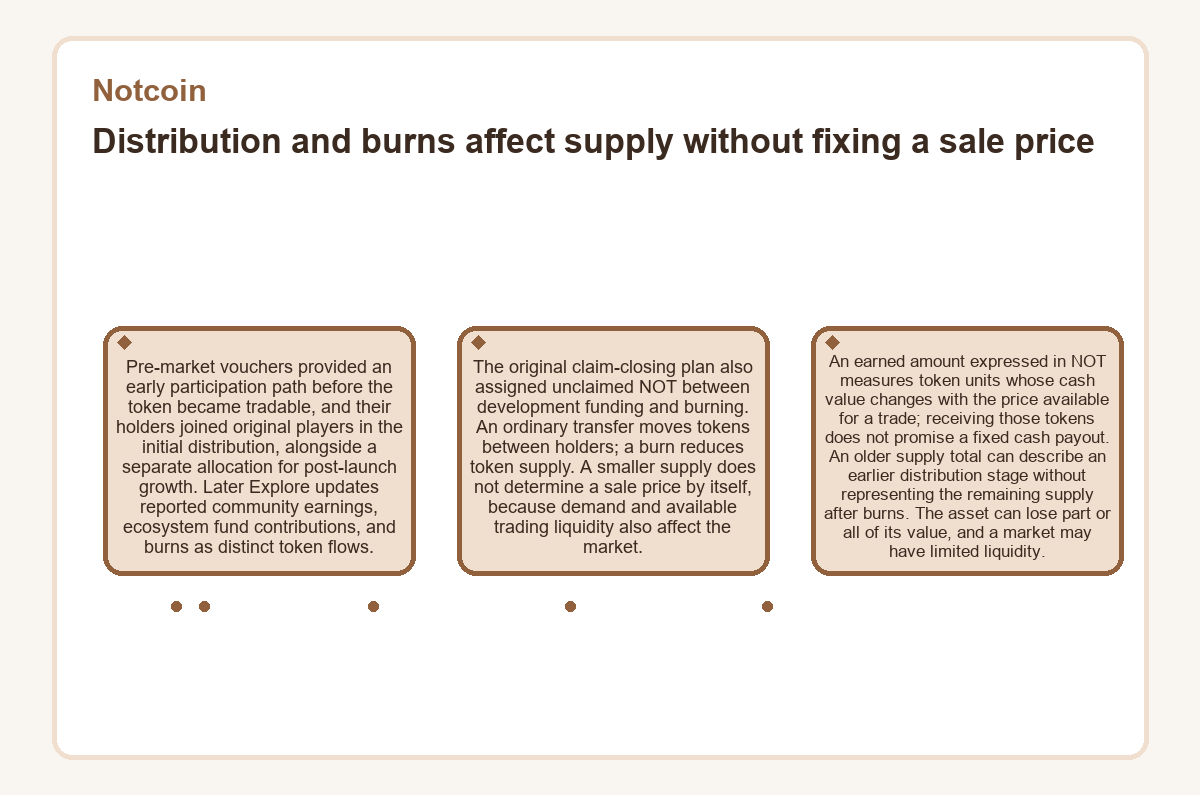
Pre-market vouchers provided an early participation path before the token became tradable, and their holders joined original players in the initial distribution, alongside a separate allocation for post-launch growth. Later Explore updates reported community earnings, ecosystem fund contributions, and burns as distinct token flows. The original claim-closing plan also assigned unclaimed NOT between development funding and burning. An ordinary transfer moves tokens between holders; a burn reduces token supply.
A smaller supply does not determine a sale price by itself, because demand and available trading liquidity also affect the market. An earned amount expressed in NOT measures token units whose cash value changes with the price available for a trade; receiving those tokens does not promise a fixed cash payout. An older supply total can describe an earlier distribution stage without representing the remaining supply after burns. The asset can lose part or all of its value, and a market may have limited liquidity.
Wallets and markets apply different custody and fee rules
NOT uses the Jetton standard for fungible tokens on TON. Compatible wallets can hold and transfer it, while market access depends on the service that handles the trade, including its account requirements and supported transfers.
Self-custody keeps control with the wallet's keys
A self-custodial wallet uses signing keys to authorize transfers. Standard on-chain fees use Toncoin, separately from the amount of NOT sent, and supported wallet features can arrange that payment on the user's behalf. Tonkeeper introduced a Battery that could be charged with NOT and pay network fees on a user's behalf, avoiding a separate TON purchase while retaining the underlying fee. Battery charges were a wallet service balance, not additional NOT holdings. Revealing wallet recovery material can expose the assets that its keys control.
Custodial accounts and decentralized markets handle access differently
Custodial providers manage signing keys and credit internal account balances. Where supported, withdrawals transfer NOT from the custodial account to an external wallet, subject to the provider's charges and restrictions. TON-based decentralized markets use wallet-held assets for trades. Access through either type of market does not require earning tokens in the original game. Trading fees, withdrawal charges, and account eligibility belong to the service's terms; the Jetton standard does not set them. A market listing alone also does not promise that every deposit or withdrawal method is available.
Choosing between token ownership and community participation
A returning player comparing these paths needs to distinguish the old game balance from existing tokens and any newly offered reward.
- If you hold NOT on TON, compare custody arrangements and the fee-payment method supported by your wallet.
- If a screen shows original tap-game coins, interpret its units and the initial claim deadline before treating it as a current token holding.
- If a campaign offers NOT, compare its eligibility, funded pool, and reward period.
- If a game awards another reward unit, keep that balance separate from NOT.
- If you buy through a service, include its account restrictions, trading charges, and supported withdrawal method in the decision.
Buying NOT concerns the price and custody of the token. A campaign offers rewards for eligible participation, while another game can use a different reward unit.
Notcoin - common questions
-
Which voucher holders qualified for the early bonus?
- The early bonus applied to snapshotted addresses for purchasers or holders of the first 5867 vouchers before pre-market access opened broadly. It was tied to that recipient snapshot, so later ownership of a voucher did not automatically qualify a new address.
-
Why did the Explore beta show less than the full earned balance?
- The early Explore beta displayed earnings from active pools only. Rewards from pools outside that active set could therefore be absent from the displayed total. A balance update was announced to correct the reporting issue. This concerned the app's earnings display, which was separate from a wallet's on-chain token balance.
-
Does every game in the ecosystem award NOT?
- Not all ecosystem game rewards use NOT. Not Pixel labels its pixel-painting rewards PX, and a Lost Dogs airdrop uses WOOF. Those are distinct reward units. A balance or prize from another game cannot be added to a NOT holding as though all the units represented the same token.
-
Are NOT holdings covered by EU deposit-guarantee schemes?
- NOT tokens are not covered by EU deposit-guarantee schemes under Directive 2014/49/EU. They are also outside investor-compensation schemes under Directive 97/9/EC. Wallet security and custody controls address different risks and do not provide these protections for the token. An exchange's support for NOT does not turn it into an insured bank deposit.
-
Can a new exchange listing change the blockchain that NOT uses?
- A new exchange listing does not, by itself, move NOT away from TON. A platform can offer a market under its own custody, deposit, and withdrawal conditions. The token's native chain and a provider's supported transfer networks are different matters. A ticker on a venue does not establish that the asset is natively issued on another blockchain.
-
What happens if I lose access to the wallet holding my NOT?
- Recovering access to NOT requires the recovery methods of the wallet or service that holds it. A self-custodial wallet needs valid recovery material or another configured recovery method. A custodial account follows its provider's recovery process. If signing access and every valid recovery method are lost, tokens can remain on-chain while you cannot spend them.